
CCNO Release Paths
A Henry County defendant ordinarily leaves CCNO after bond or recognizance release, dismissal, completion of a local sentence, or another court-authorized event. That community exit should be documented in the jail's release transaction. The committing court supplies the legal order. Ohio VINE may add a custody-event notice, but the booking and release record remains the direct jail source.
A prison conveyance is different. CCNO says most men sentenced to an Ohio prison are transported to the Correctional Reception Center, while women are transported to the Ohio Reformatory for Women. They remain in custody. After ODRC admission, the statewide Offender Search should show an incarcerated status, institution, sentence data, and an expected release or parole-eligibility field. Classification may later place the person at another ODRC institution.
The official CCNO prison-transfer policy shown below identifies those receiving paths and related property rules.
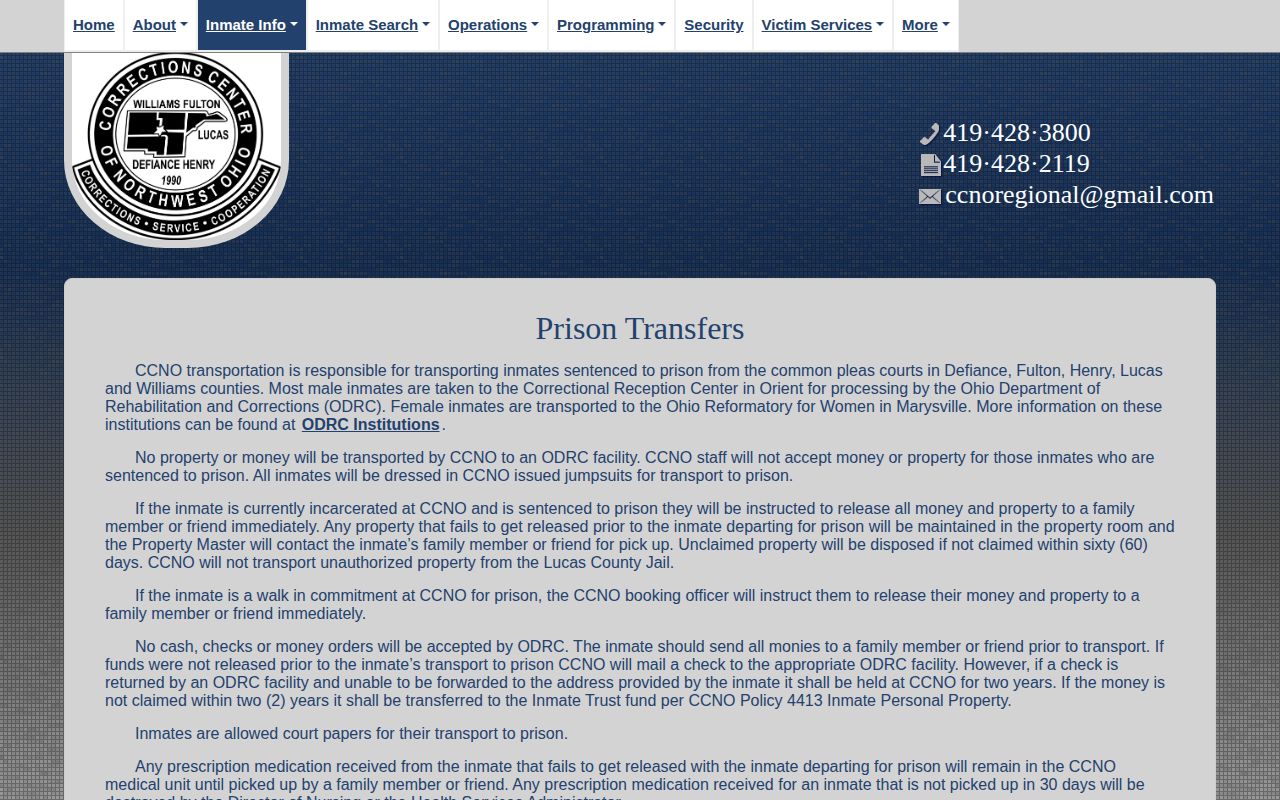
The transfer page helps identify the next locator, while the CCNO exit code distinguishes a prison conveyance from release to the community.
Confirm a CCNO Release
The active population report is useful before an exit. It lists a booking number, case, charge, committing court, court status, in date, and Estimated Out Date. It is not a release archive. Once a row disappears, the reason can be community release, transfer, movement under another authority, data timing, or a search mismatch.
- Open the CCNO active search and match the booking number, name, case, and committing court.
- Use the CCNO archival search after the live row drops. Search by name, CCNO number, or booking dates and inspect the matched detail.
- Read the Henry Common Pleas or Napoleon Municipal Court docket for the bond, dismissal, sentence, jail-credit, release, or conveyance order.
- Check Ohio VINE for the same identifier and source. Read the exact event because transfer, general release, escape, and death have different meanings.
- Request the CCNO booking and release record with the release date, time, code, destination, and receiving agency when maintained.
The CCNO Ohio VINE gateway captured below is the local notification layer for a custody change.
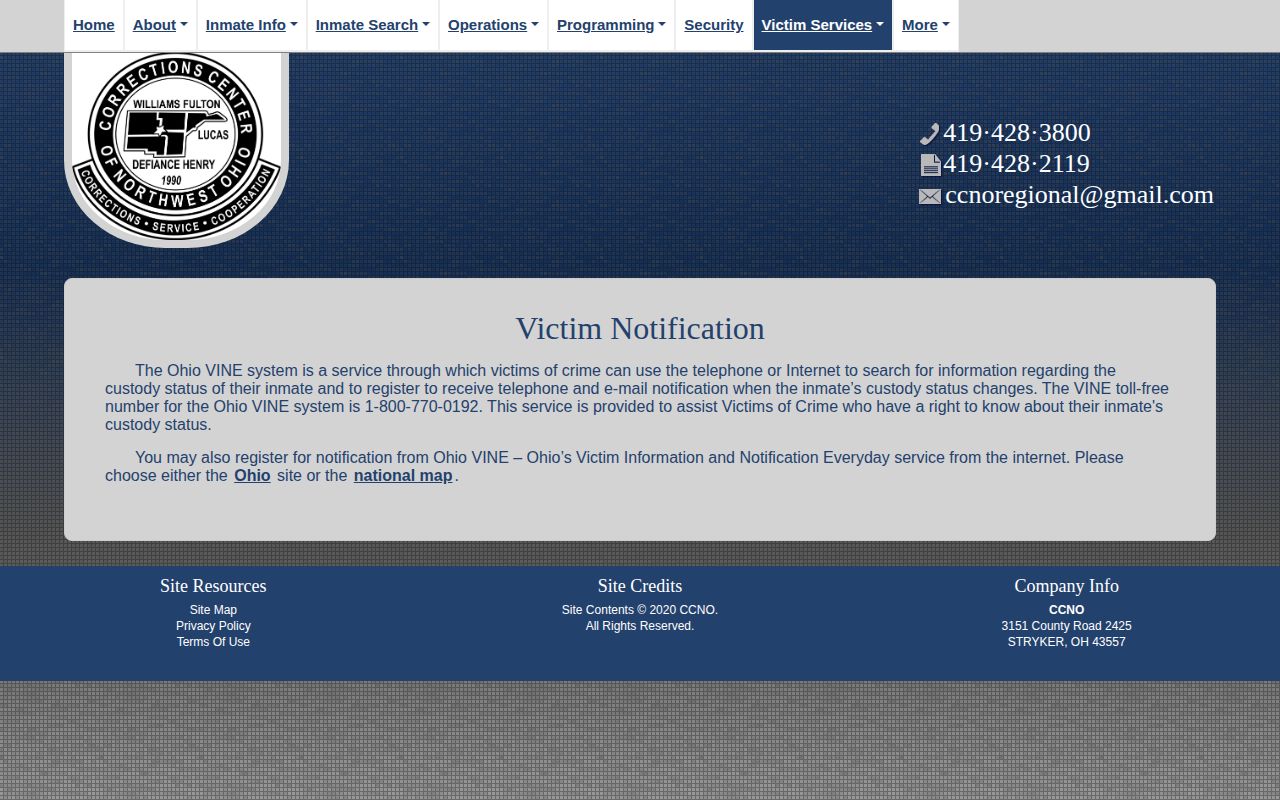
A VINE event is a useful confirmation lead. The creating court and CCNO release transaction still supply the durable event record.
CCNO Records and Contact
CCNO publishes four public-record channels. A requester may email, mail, call, or appear during records-office hours. Ask for existing records rather than a custom explanation. The booking number and court case help staff locate the correct release in a facility that serves several jurisdictions.
Corrections Center of Northwest Ohio03151 County Road 2425
Stryker, OH 43557
419-428-3800, records extension 201
ccnoregional@gmail.com
Monday-Friday, 8:00 a.m.-4:00 p.m.
A focused request can seek the booking sheet, admission date and time, release date and time, release or transfer code, destination or receiving authority, property receipt, related court and case, and booking photograph. CCNO lists a cost of 25 cents for each single-sided letter-size paper copy. Confirm the cost for electronic delivery or other media. Ohio law uses a reasonable-period standard, not a guaranteed number of days.
The official CCNO records page below displays the channels, hours, and copying policy.
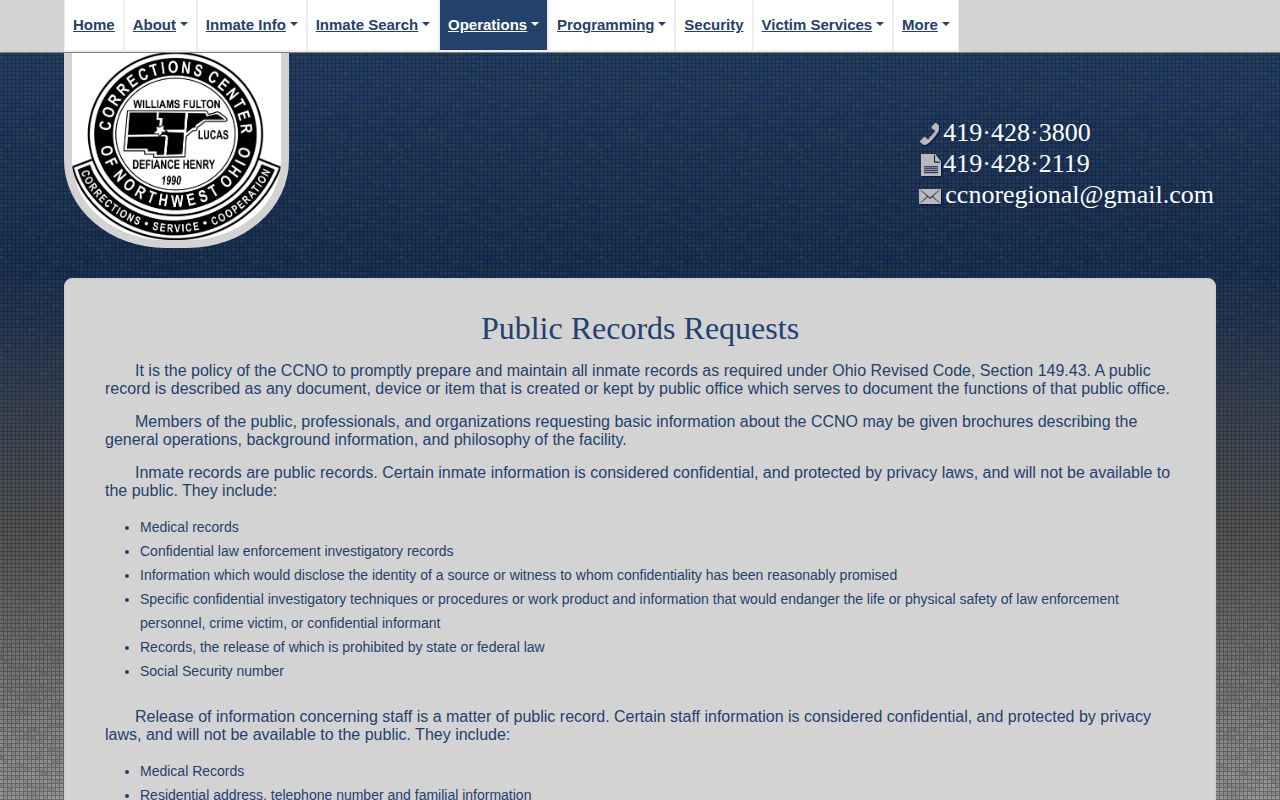
The records page is the primary historical-release route when the active jail snapshot no longer contains the person.
Ohio's First Regional Jail
CCNO's regional structure explains why the jail serving Henry County is physically in Williams County. The facility was created in 1987 and has operated since 1990 under the multicounty correctional-center authority in Ohio Rev. Code §307.93. Its annual report describes CCNO as Ohio's first regional jail and one of only four regional jails in the state.
The Corrections Commission of Northwest Ohio governs the facility. Its member jurisdictions include Defiance, Fulton, Henry, Lucas, and Williams Counties. The jail also serves Findlay Municipal Court and federal contract custody. That mix makes the committing-court field as important as the person's name. A row with a Henry court points toward Henry's docket, while a federal court line follows a federal path.
CCNO reports 4,602 bookings and 4,520 releases for 2025, an average population of 560, funded capacity of 576, and an average stay of 35.74 days. Those are facilitywide figures across all member and contract populations. They are not Henry County release totals. CCNO separately reports Henry County's 2025 average daily population as 27.
CCNO Federal Custody Releases
CCNO lists 202 beds allocated under its U.S. Marshals Service contract, compared with 37 funded Henry County beds. The scale of that federal presence changes release interpretation. A person can disappear from CCNO's active list because USMS moved them for court, transported them to another contract jail, or delivered them to a Bureau of Prisons facility. None of those events proves freedom.
For a federal pretrial or holder case, follow the federal court docket and USMS custody path. The Henry Common Pleas and Napoleon Municipal dockets do not control the federal matter. BOP Find an Inmate becomes useful after BOP designation and for many former federal prisoners, where a record may show Released or Not in BOP custody with a date. A person held only by USMS before trial may never appear in BOP's public locator.
An immigration detainer also requires a separate distinction. Transfer to ICE is continued custody, not a general release. Use ICE's official detainee locator or detention information line when the CCNO release record names that destination. Do not infer immigration custody from a name or a blank locator result.
Note: Holding authority and destination determine the next search, so preserve the federal court, agency, and transfer fields before the active row changes.
CCNO Charge-Level Release Estimates
The Active Offender Population PDF places “Estimated Out Date” beside charge and court data. In a multi-authority jail, that layout matters. One person can have multiple cases, and a date shown for one line may not clear another case, warrant, consecutive term, federal hold, or transfer order. Treat it as a planning clue rather than a countdown.
A pretrial person may have no fixed date because bond and court action can change. A local sentence depends on the judgment, jail credit, other cases, and CCNO's calculation. ODRC earned-credit rules do not automatically control a term served only at CCNO. No Henry or CCNO weekend-release policy was verified, so a listed date should not be moved based on an assumed practice.
Require a positive exit record and destination. A release code showing bond or sentence completion differs from a transfer entry naming CRC, ORW, USMS, ICE, or another county. The Henry County inmate release date resource explains the separate state-prison date labels and Ohio sentence rules.
CCNO Prison Transfer Property
CCNO says ordinary property and money do not travel with a person transported to ODRC. Property left after prison transport is held for pickup by family or friends and disposed of if unclaimed after 60 days. Prescription medication has a 30-day pickup period. Certain funds that cannot be forwarded can be held for two years before transfer to the inmate trust fund.
These deadlines concern a prison transfer. They should not be presented as the rule for every community release. The release or transfer record should first identify the event, then the prison-transfer policy supplies the property instructions. A family member should use the current facility contact before traveling because authorization, identity, and item status may need confirmation.
Read CCNO Release Records
A complete record should establish identity, source, event, time, and destination. The field names may vary, but the request can describe the existing information needed. Medical and other protected information is not part of the ordinary release proof.
| Field | Why it matters |
|---|---|
| Booking number and name | Connects the exit to the correct CCNO admission |
| Admission and release date/time | Defines the physical custody interval |
| Release or transfer code | Separates community release from continued custody |
| Destination or receiving agency | Identifies ODRC, USMS, ICE, another jail, or community exit |
| Case and committing court | Points to the legal order behind the event |
| Property receipt | Documents handling of property at exit when maintained |
For the full named-person search chain and release-record request language, use the Henry County released inmates search. Keep the court order, CCNO transaction, and any receiving-system record together when the destination is disputed.
Older records need the same identifiers. CCNO does not publish how long a released row stays online or a public schedule for every release field. If the archive does not resolve an old booking, ask for the existing record-retention entry along with the release packet. Ohio's public-record law concerns records the office keeps; it does not require staff to invent a new historical list or narrative.