
Henry County Release Date Meaning
A future date is a forecast, not an exit record. CCNO calls its field “Estimated Out Date.” The Ohio Department of Rehabilitation and Correction uses the combined label “Expected Release Date/Parole Eligibility Date.” Each label can point to a different event. A definite prison term may yield an expected end date after official sentence calculation. An older indeterminate sentence may instead show the first date when the Ohio Parole Board can consider release. Eligibility does not require the Board to grant release.
The actual date is established after the person leaves the authority that held them. For a CCNO case, that proof is the release or transfer entry, supported by the court order and an Ohio VINE event when available. For a state prisoner, ODRC admission and release history or a status such as Released, Judicial Release, or APA Supervision can document physical release. APA Supervision means the person is outside ordinary prison confinement but remains under Adult Parole Authority control.
Find Henry County Release Dates
Start with the custody system that now holds the person. CCNO serves Henry County jail cases, but it is a regional jail in Stryker and also houses people for other counties and the U.S. Marshals Service. The committing court and case number identify which authority controls a local date. ODRC Offender Search is relevant only after a person enters state custody or comes under ODRC supervision.
- For a current CCNO record, open the official CCNO inmate search. Match the booking number, case, charge, and committing court before reading an Estimated Out Date.
- Open the Henry County court case through the Clerk of Courts gateway or use the official Napoleon Municipal Court site when that court controls the case. Read the journalized sentence, bond, release, jail-credit, or conveyance entry.
- For a state prisoner, use ODRC Offender Search. Search broadly at first, then match the offender number, county, docket, offense, institution, and status.
- Record the exact public label and the date checked. If the field combines release with parole eligibility, do not shorten the label or turn it into a promise.
- Confirm an exit with CCNO records, the ODRC release history, or the creating court and agency. A VINELink Release Check can add a custody-change notice, but it is not a certified discharge record.
ODRC recommends using less search criteria when a narrow search returns nothing. A complete offender number uses an A, R, or W prefix and six digits, with a leading zero when required. County of Commitment can narrow a Henry case, though one person may have more than one committing county. Match the number rather than relying on a common name.
CCNO Estimated Release Dates
The CCNO Active Offender Population report places “Estimated Out Date” beside case, charge, court, and status data. This is a charge-level field in a multi-authority jail. One person can have several cases, and each line may carry a different court status or projected date. A date beside one charge does not show that another case, warrant, sentence, federal hold, or transfer order has ended.
A pretrial person usually has no fixed sentence-expiration date. Bond may be posted, changed, revoked, or made subject to conditions. A charge may be dismissed, or another court can still hold the person. Someone serving a local sentence has a stronger basis for a computed date, but the judgment, court-awarded credit, any consecutive case, and the jail's own calculation still control. ODRC earned-credit rules do not automatically apply to a person serving only a county-jail term.
CCNO has not published a Henry-specific weekend or holiday early-release policy. Do not move a date on a calendar based on an assumed practice. Ask CCNO for its existing sentence-calculation or release record and ask the court for the journal entry. The broader Henry County released inmate search explains how to confirm the completed exit and distinguish it from a transfer.
Note: A missing CCNO row can reflect release, transfer, federal movement, data timing, or a search mismatch, so absence alone proves nothing.
Ohio Henry Release Calculations
Ohio sentence calculation begins with the court's final judgment. The record must show whether terms are definite, indefinite, life-based, or an aggregate of several cases, and whether the terms run at the same time or one after another. Court-awarded confinement credit is then applied. Ohio Rev. Code §2967.191 addresses credit for days confined for reasons arising from the offense, subject to its exact terms and the court's calculation.
Modern definite felony terms are imposed under §2929.14. Lawful jail credit, eligible earned credit, judicial release, corrected orders, and other specific legal authority may affect the official calculation. Judicial release is a court process under §2929.20; an application alone does not change the date. Only a granted journal entry followed by the prison exit confirms that event.
The ODRC detail may also show a POA/PRD date, supervision dates, or parole-review information. Those fields should not be merged. A supervision end date can occur long after physical release. A hearing month shows a scheduled review, not the outcome. ODRC also warns that sentence information on the public detail may be incomplete, so a complex date should be checked against Central Records and the court judgment.
- Definite term
- A stated prison term whose official end date is computed under the judgment and applicable law.
- Indeterminate term
- A sentence with minimum and maximum terms or older parole-eligibility rules.
- Jail-time credit
- Credit the court calculates for qualifying confinement connected to the offense.
- Detainer
- A notice that another authority may take custody or require the person to remain held.
Henry Release Earned Credit
Ohio does not have one safe “serve 85 percent” shortcut for every sentence. The earned-credit statute is category-specific. Under the reviewed version of Ohio Rev. Code §2967.193, some eligible participation can earn one or five days for each completed month. Certain qualifying program completions can produce 90 days or ten percent of the stated term, whichever is less. The ordinary monthly and completion aggregate is generally subject to an eight-percent provision.
Those figures cannot be applied to every Henry County sentence. Mandatory terms, offenses of violence, sexually oriented offenses, and other barred or limited sentences may not qualify in the same way. Eligibility also depends on the law tied to the offense and sentence, satisfactory participation, exclusions, caps, and credits that ODRC actually awards. Loss or restoration may change the computation later.
The useful public answer is the ODRC expected-date field after official calculation, not a home-made subtraction from the announced term. When records conflict, write to ODRC Central Records, Attn: Central Records, P.O. Box 430, Columbus, OH 43216, with the offender number and ask for the existing sentence computation and release history. The court supplies its judgment and jail-credit order; ODRC supplies the prison computation.
Henry Indefinite Release Dates
Qualifying first- and second-degree felonies committed on or after March 22, 2019 can fall under Ohio's indefinite minimum-and-maximum framework. Ohio Rev. Code §2967.271, read with §§2929.14 and 2929.144, generally presumes release at the minimum or a rebuttal period. ODRC may rebut that presumption after the hearing required by law and continue confinement, but not beyond the maximum term.
That structure makes even a minimum or expected date conditional. The person may have another sentence or hold, and a statutory rebuttal can move the actual exit. For older indeterminate sentences, §2967.13 contains parole-eligibility rules that vary by sentence and offense. The first eligible month merely opens Board review. A denial or continuance can place release much later.
The ODRC definitions page explains the public fields and should be read before assigning a meaning to them. The official ODRC definitions shown below help separate status and date labels from an accomplished discharge.
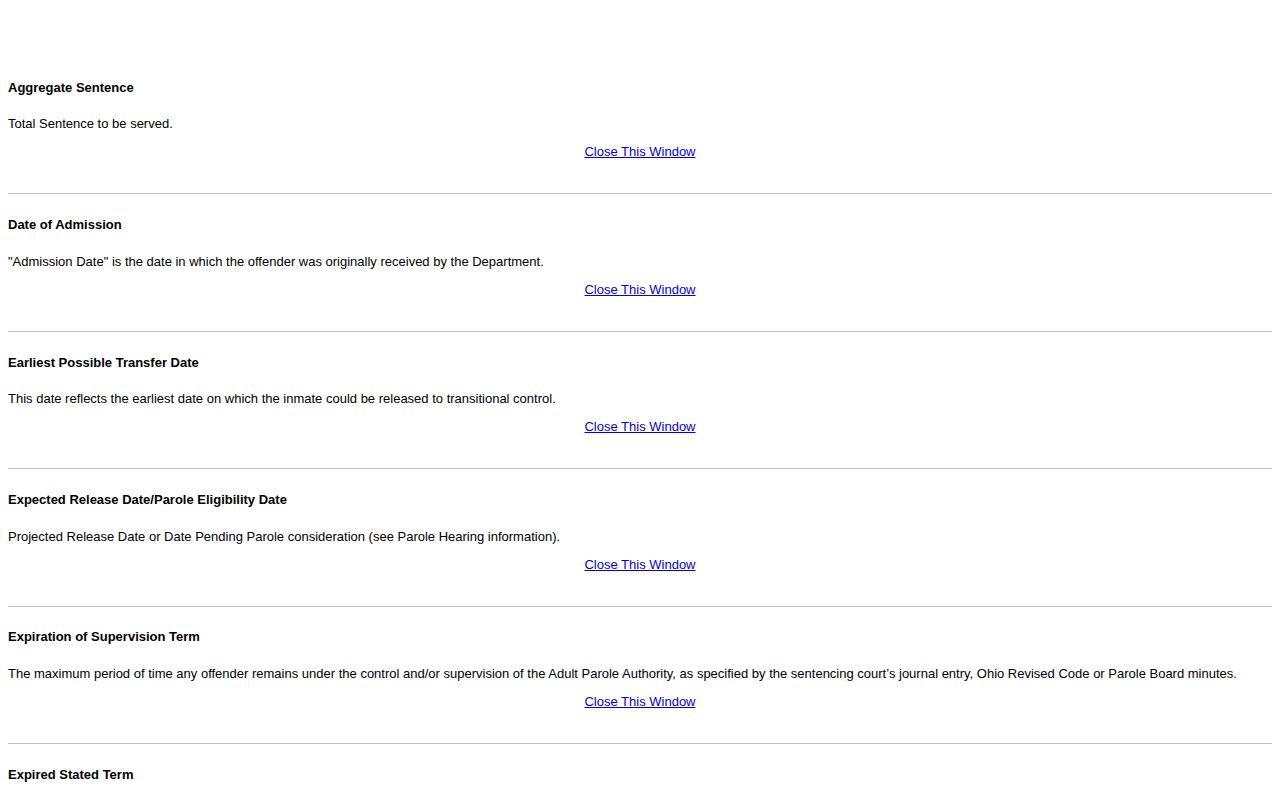
The definitions screen supports careful reading, but the person-specific detail, court judgment, and ODRC calculation remain the records to match.
What Moves Henry Release Dates
A date can move because the underlying legal or custody facts changed. The event should be traced to the office that created it. CCNO cannot alter a court judgment, and the clerk cannot revise an ODRC computation. Compare the newest dated records rather than assuming an older screenshot remains current.
| Factor | Possible effect | Record to verify |
|---|---|---|
| Corrected jail credit | Moves the calculated term after a court correction | Court journal entry and ODRC computation |
| Concurrent or consecutive cases | Changes whether terms overlap or follow each other | Each controlling judgment |
| Earned-credit award or loss | Changes only the credit allowed and posted by ODRC | ODRC sentence computation |
| Detainer or another authority | May block community release or cause transfer | CCNO release code and receiving-agency record |
| Parole Board action | May grant, deny, or continue review for an eligible sentence | Person-specific hearing result and ODRC status |
| Judicial release or later order | Can change the planned prison term if granted | Signed court entry and ODRC exit |
A transfer deserves special care. A CCNO exit to the Correctional Reception Center, Ohio Reformatory for Women, another jail, USMS, or ICE is not a release to the community. The destination field or receiving-system admission resolves that question.
One Date May Miss Holds
CCNO's “Estimated Out Date” appears with charge and court information rather than as a stand-alone completed-release event. That layout matters in Henry County because a single person may have several county, municipal, or federal matters. One line can reach its estimated end while a second line still supplies legal authority to hold or transfer the person.
Require a positive exit record and a destination. A release code showing bond or sentence completion points in a different direction from a transfer code naming ODRC, USMS, ICE, or another jail. Ohio VINE can add a dated event, while the court docket explains the order behind it. None should be replaced by a countdown built from one active-report field.
Note: Confirm the date again near the expected exit because new court entries, holds, credit changes, and transfer orders may appear.