
Releases From ODRC Institutions
ODRC institutions hold people serving state-prison sentences. No state prison was identified as physically located in Henry County, yet a Henry County Common Pleas conviction can lead to an ODRC placement anywhere suitable after reception and classification. CCNO says most men sentenced to prison are first transported to the Correctional Reception Center in Orient, while women are transported to the Ohio Reformatory for Women in Marysville. That CCNO exit is a conveyance into state custody.
A later ODRC exit may lead to the community with no department supervision, to parole or post-release control under the Adult Parole Authority, or to a status tied to judicial release. Parole is discretionary release for eligible people under applicable indeterminate law. Post-release control is supervision that follows specified modern felony terms. Judicial release comes from a sentencing court under Ohio law and may include community control. Each means the person is outside ordinary prison confinement, but they do not all mean supervision has ended.
Confirm an ODRC Institution Release
The ODRC Offender Search is the first public route for a former state prisoner. It expressly includes people currently incarcerated, under department supervision, judicially released, and released. Search broadly first. A narrow county filter can miss a person with more than one committing county, while a name-only result must still be matched with an offender number and case facts.
- Enter the last name, or use the complete offender number when known. ODRC numbers use an A, R, or W prefix and six digits.
- Try All first, then compare Incarcerated, Released, APA Supervision, and Violators at Large status filters as the facts require.
- Open the detail and match the offender number, identity, county of commitment, docket, offense, and sentence.
- Read admission, institution, release, supervision, and hearing fields in context. Keep the page's record date.
- Compare the result with the Henry County court judgment or judicial-release order. Request an ODRC record when formal proof is needed.
The broader Henry County released inmate search can help when it is unclear whether the person stayed at CCNO, entered ODRC, or moved into a different custody system.
Henry County Prison Reception Path
Reception is the intake and classification stage for a state sentence. CRC is the usual male reception destination named by CCNO. ORW is the named destination for women. Classification can then move a person to another ODRC institution, so the reception center is not always where the full term is served. The statewide offender detail, not a static reception assumption, identifies the institution recorded by ODRC.
Match two records at this boundary. The CCNO transaction should show transfer or conveyance out of the regional jail. The ODRC record should show admission into state custody and an Incarcerated status. A gap between the two systems can reflect transport and posting time. It does not turn the CCNO exit into freedom. Once ODRC has received the person, ODRC becomes the authority for state-prison placement, sentence computation, projected date, release, and APA supervision.
Note: An institution can change after classification, but the offender number remains the strongest key for following the statewide record.
ODRC Release Record Fields
ODRC uses terms that answer different questions. A future date may help with planning, but it cannot prove that a release occurred. A past status and release entry are stronger. The detail also warns that sentencing information may be incomplete and that a displayed supervision period can arise from a prior offense. Read the whole identity and sentence record before relying on one line.
| ODRC field or status | Meaning for release review |
|---|---|
| Incarcerated | The person remains in an ODRC institution, even if CCNO no longer lists the person. |
| Released | A positive state-system status supporting physical exit from ODRC custody. |
| APA Supervision | The person is outside ordinary prison confinement but remains under Adult Parole Authority supervision. |
| Judicial Release | The sentencing court authorized an early prison exit under the applicable Ohio framework. |
| Violators at Large | An official APA category that is not the same as compliant supervision or final discharge. |
| Expected Release Date/Parole Eligibility Date | A combined forward-looking label that can mean projected expiration or eligibility for Board review. |
Additional details may show an APA office, supervision dates, a next hearing or review month, and the latest hearing type or result. A favorable hearing result can precede the actual release transaction. Confirm the completed exit through the updated status and record.
ODRC Expected and Actual Release
“Expected Release Date/Parole Eligibility Date” combines two legal concepts. A definite sentence can produce an expected end date after ODRC's official calculation. An older indeterminate sentence may instead produce the first date on which the Ohio Parole Board can consider release. Eligibility does not require the Board to grant release. A denial, continuance, or later review can move the physical exit beyond that first date.
The calculation begins with the journalized sentence and whether multiple cases run together or one after another. Court-awarded confinement credit under Ohio Revised Code §2967.191 can reduce the term for qualifying confinement. Earned credit under §2967.193 depends on the statute, offense, sentence, approved activity, exclusions, caps, and ODRC awards. There is no safe universal rule that every Ohio prisoner serves the same percentage.
Dates can change after corrected jail credit, court orders, disciplinary credit action, parole decisions, judicial release, detainers, post-release violations, or administrative correction. Use the official ODRC date and its last recorded context. Do not turn it into a countdown or a guaranteed discharge day.
ODRC Release and APA Supervision
Physical release and final discharge are different milestones. APA Supervision means the person has left ordinary prison confinement but remains under ODRC authority through parole, post-release control, or another category assigned by law. The detail may identify the APA office and supervision period. The official status is more reliable than a last known address, which should not be treated as a current location.
Parole applies to eligible people, often under older indeterminate sentencing rules, and depends on Ohio Parole Board action. Post-release control follows specified newer felony sentences. A person can also leave through judicial release ordered by the sentencing court and then serve community control. When the status later changes to final discharge, preserve that separate date. The earlier prison release does not itself prove that all supervision ended.
Use the exact status and date. “Violators at Large” is an official APA category, not a label to infer from missed contact or stale information. Questions about a public detail should be directed through ODRC channels with the offender number.
ODRC Release Records Contact
The statewide search is useful for verification, while Central Records is the documented route for questions about the underlying ODRC documents. Request existing admission and release history, status or discharge records, and sentence computation with the offender number. Do not request an entire institutional or APA file as though every part were public.
ODRC Central Records
Attn: Central Records
P.O. Box 430
Columbus, OH 43216
Include the complete offender number and the exact record or date field sought.
Ohio Revised Code §5120.21 limits wholesale access to institutional and APA files but permits disclosure of specified basics, including name, convictions, photograph, supervision status, and current and past incarceration. A focused request should anticipate lawful redactions. For a court-certified judicial-release order, use the Henry County Clerk rather than asking ODRC to certify a court record.
Note: ODRC copying methods and charges were not established in the research, so confirm them with Central Records before ordering copies.
Read ODRC Release Definitions
The official ODRC search definitions explain status and date labels used in offender details. The captured source below is relevant when a Henry County sentence has entered the state-prison system:
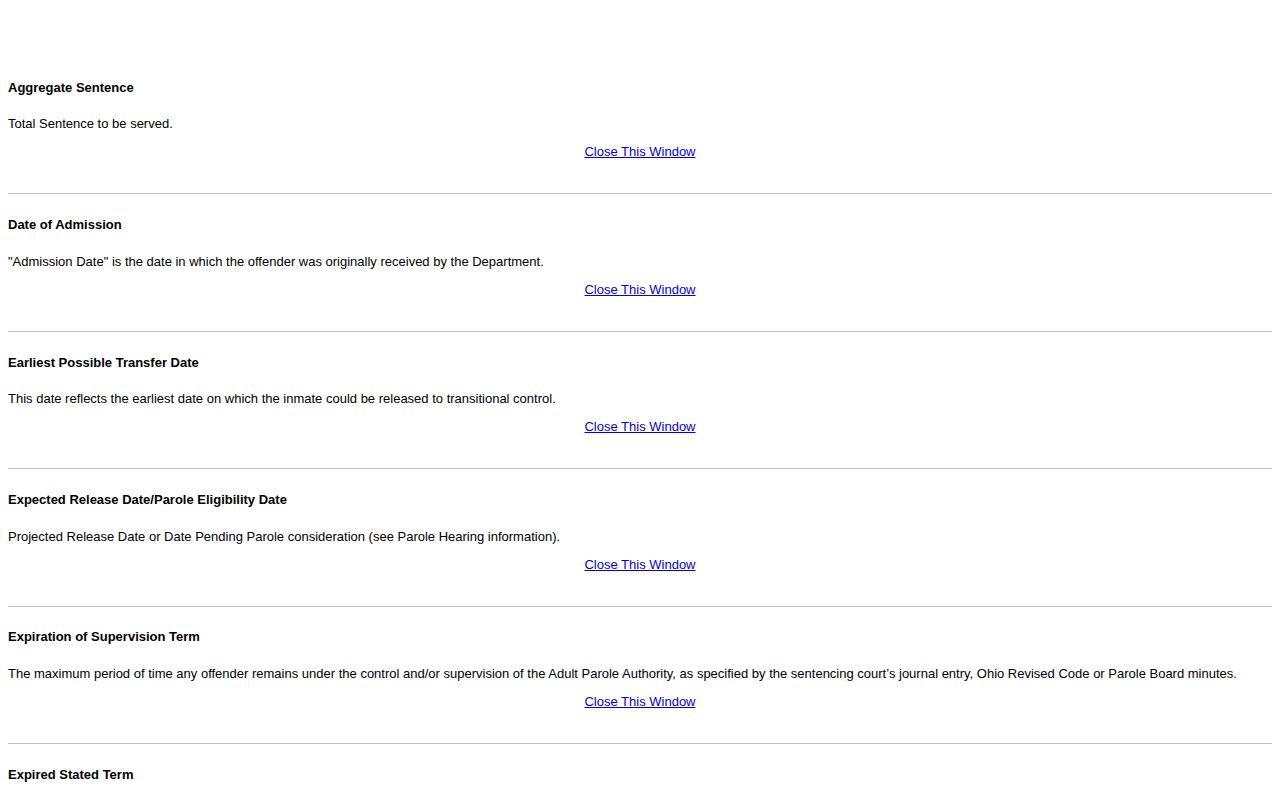
The definitions help separate a hearing or eligibility date from a completed release. Always pair them with the person's current official detail and record date.
Federal CCNO Exits Are Different
CCNO's large federal role can send a search down the wrong path. The regional jail lists 202 U.S. Marshals Service contract beds compared with 37 allocated Henry County beds. A federal detainee who leaves CCNO may go to court, another contract jail, a Bureau of Prisons facility, or the community. That exit does not create an ODRC admission unless a separate state commitment exists.
USMS generally controls federal custody while a case is pending. The BOP inmate locator becomes useful after federal designation and for many former federal prisoners. It can display Released or Not in BOP custody with a date, but the latter wording alone does not rule out custody by another authority. Use the federal docket and USMS information to explain the movement.
ODRC search should remain limited to Ohio state custody. It does not cover a federal pretrial stay at CCNO, an ICE transfer, or a juvenile placement. Keeping the sovereign and receiving agency attached to each exit prevents a transfer from being mislabeled as release.